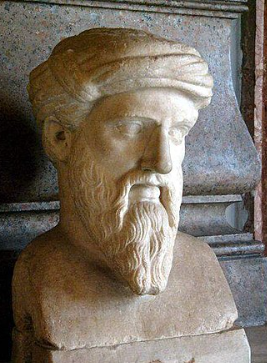
Pitagora (c. 570–495 BCE) was an ancient Greek philosopher and mathematician, best known for his contributions to mathematics, particularly the Pythagorean theorem, as well as his influence on Western philosophy, science, and spirituality. He is considered one of the most significant figures in the pre-Socratic period, and his ideas shaped both the intellectual and esoteric traditions in Europe for centuries. Here’s an overview of his life, work, and legacy:
1. Life of Pythagora
- Early Life: Pitagora was born on the island of Samos, located in the Aegean Sea, around 570 BCE. He traveled extensively in his youth, visiting Egypt, Babylon, and possibly India, where he studied mathematics, astronomy, music, and religious rites.
- Foundation of the Pythagorean School: Around 530 BCE, he moved to Croton in southern Italy, where he founded the Pythagorean school, a religious and philosophical community that sought to combine science, spirituality, and morality. The school functioned like a brotherhood, with strict rules about personal behavior, including dietary restrictions (vegetarianism) and a focus on asceticism.
- The Pythagorean Brotherhood: Pitagora’s followers were divided into two groups: the mathematikoi (those who studied mathematics and scientific disciplines) and the akousmatikoi (those who focused on the religious and mystical aspects). Members of the Pythagorean Brotherhood followed communal living practices and adhered to a code of secrecy, contributing to the air of mystery surrounding Pitagora’s teachings.
2. Mathematical Contributions
- Pythagorean Theorem: Pitagora is most famous for the Pythagorean Theorem, a fundamental principle in geometry that states the square of the hypotenuse (the side opposite the right angle) of a right triangle is equal to the sum of the squares of the other two sides. Mathematically, this is expressed as a2+b2=c2a^2 + b^2 = c^2a2+b2=c2. Although this principle was likely known to the Babylonians before him, Pitagora’s school provided formal proof and made it central to their mathematical studies.
- Numbers as the Foundation of the Universe: Pythagora and his followers believed that numbers were the fundamental principle underlying the universe. They held that everything in the world could be explained and understood through numbers and mathematical relationships. This idea had a profound influence on later thinkers and contributed to the development of the field of numerology.
- Numerical Mysticism: Pitagora viewed numbers as having both mathematical and mystical significance. He associated certain numbers with specific virtues and qualities, such as harmony, justice, and balance. For example, the number 10 was considered the most sacred, representing the Tetractys (a triangular figure made up of ten dots arranged in four rows), which symbolized the unity of space and time.
3. Philosophical and Spiritual Beliefs
- Harmony and Music: Pythagora is credited with discovering the mathematical relationships that underlie musical harmony. He realized that the intervals between harmonious sounds could be expressed as simple numerical ratios. This led to the idea that the cosmos itself was governed by a kind of mathematical harmony, sometimes referred to as the „music of the spheres.“
- Transmigration of Souls: Pitagora was a strong proponent of the idea of metempsychosis, or the transmigration of souls, which is the belief in reincarnation and the immortality of the soul. He believed that the soul passed through cycles of reincarnation, taking on different bodies in each life, and that through spiritual purification, one could escape this cycle.
- Philosophy of Dualism: Pitagora’s teachings often emphasized dualistic ideas, such as the opposition between the finite and the infinite, light and dark, or good and evil. This dualism became an influential concept in later philosophical and spiritual systems.
4. Influence and Legacy
- Impact on Western Philosophy: Pythagora’s ideas deeply influenced later philosophers, especially Plato and Aristotel, and played a role in the development of Platonism and Neoplatonism. Plato’s theory of Forms and his belief in the abstract reality of numbers were likely influenced by Pythagorean thought.
- Mathematics and Science: Pythagora laid important foundations for the study of mathematics and astronomy. His emphasis on logic, proportion, and harmony inspired future generations of mathematicians and scientists.
- Esoteric and Mystical Traditions: Pitagora’s blending of science, mathematics, and spirituality contributed to the rise of esoteric and mystical traditions in Western thought. His ideas on reincarnation, numerology, and the connection between numbers and the cosmos influenced movements like Hermeticism and Alchemy, as well as later thinkers in the Renaissance.
- Symbolic Legacy: Many symbols and concepts associated with Pythagora, such as the Pentagram (a symbol used by the Pythagoreans), have persisted in various philosophical, religious, and occult traditions.
5. Myths and Mysticism
Due to the secretive nature of the Pythagorean Brotherhood, many myths and mystical stories have arisen around Pythagora:
- Supernatural Powers: Some ancient sources claim that Pitagora had supernatural abilities, such as the power to communicate with animals or control natural phenomena. These accounts are likely exaggerated, reflecting the reverence in which his followers held him.
- Mystical Numbers: Pitagora and his followers assigned mystical properties to numbers. For example, the number 3 was considered the number of harmony and wisdom, while the number 4 represented justice.
- The Tetractys: The Tetractys, a sacred symbol to the Pythagoreans, represented the sum of the first four numbers (1+2+3+4 = 10) and was considered to hold deep metaphysical meaning. It was seen as a symbol of the structure of the universe and the divine order.
6. Death and Legacy
Pythagora’s death is shrouded in mystery. One story suggests he died after a political conflict in Croton, while another claims he fled and spent his final years in exile. Despite his death, his ideas lived on through his followers and the Pythagorean Brotherhood, which continued to thrive for centuries
Pythagora remains one of the most influential figures in the history of philosophy, mathematics, and mysticism. His blending of rational thought with spirituality laid the groundwork for many future developments in Western thought. His mathematical discoveries, particularly the Pythagorean theorem, remain central to modern mathematics, while his philosophical and spiritual teachings continue to inspire those seeking to understand the deeper nature of reality through the lens of harmony, proportion, and number.